
 Physics-informed performance intelligence
Know more. Burn less. Perform better.
Your ships already send the numbers every day. Naval Brain reads them, applies the physics of how hulls actually behave, and tells you — to the dollar, per vessel, per day — where the money is bleeding.
Hardware
None
Your superintendent doesn’t want another retrofit project. We work from the noon reports your crew already produces.
Output
$ / day
Not percentages. Not a dashboard full of graphs. To play the game you need the necessary numbers: Money, Emissions, Penalty.
Standards
ISO 19030
Every output traces to a standard your class surveyor recognises.
The problem
Fouling is continuous. Your view of it shouldn’t be twice a year.
Every hull degrades. Every day a vessel sails, a fraction of its fuel is paying for fouling rather than progress. That number is invisible. Until today.
Naval Brain turns your daily noon reports into a defensible, ISO-aligned number: how much of your fuel is paying for the hull.
Diagnostic layer
Hull Intelligence.
The diagnostic layer of the platform. Each noon report becomes a new point on the hull’s degradation curve, with confidence bounds, data-quality flagging, and provenance back to every enrichment step. If the inputs are weak, the output says so.
Built around ISO 19030’s nb_drift, anchored to the vessel’s own sea-trial baseline, cleaned through a Kalman filter and smoothed with a Neural ODE.
Hull degradation trajectory
Live hull degradation trajectory · 95% CI · ISO 19030
nb_drift 5.08%
95% CI [4.77, 5.41]
source ISO 19030
Decision layer
Decision Support.
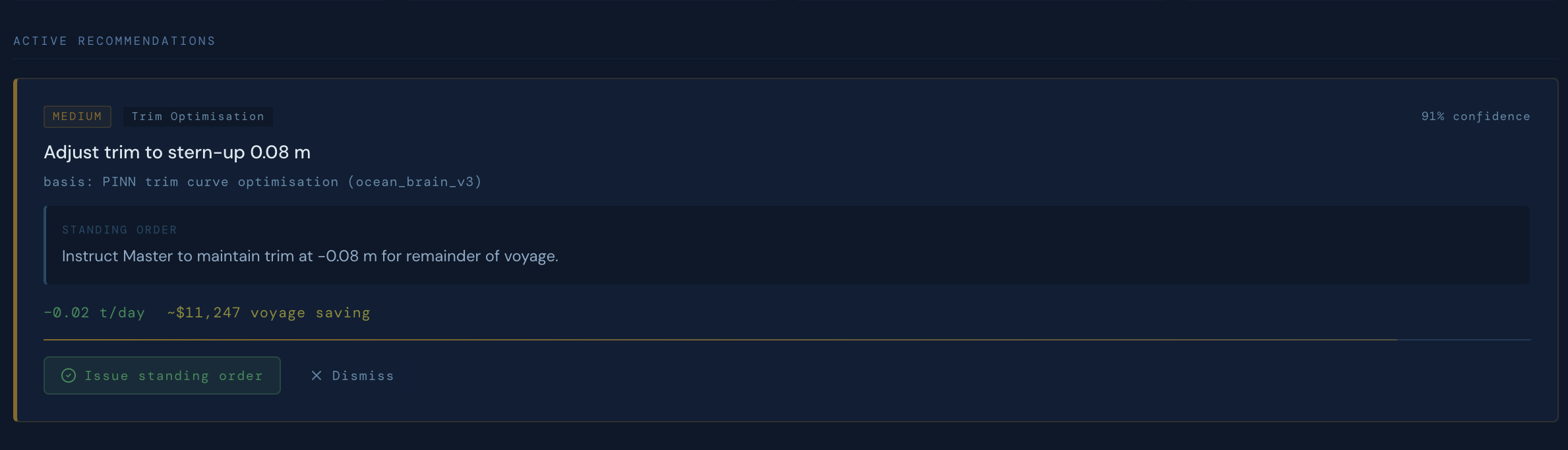
Hull Intelligence diagnoses. Decision Support acts. Every recommendation carries its physical basis, a confidence score, and an expected voyage saving in dollars — ready to issue as a standing order to the Master.
Trim optimisation, speed band, drydock timing. One click to issue, one click to dismiss. The Master, the superintendent, and the commercial team see the same object.
Built on
ISO 15016
ISO 19030
Holtrop & Mennen
Townsin 1981 · 2003
ITTC-78
Naval Brain
Limassol, Cyprus
Technology
Physics-informed Network of Data. Auditable. Not a black box.
Every output traces to standardized papers, creating defensible and useful numbers you will see nowhere else.
Deployment
Global coverage, per-vessel precision.
Every vessel streams AIS continuously, cross-referenced against its noon reports, route weather, and the sea-trial baseline. The platform works the same way whether you monitor three ships or three hundred.
Onboarding is a data feed, not a deployment. No hardware. No onboard software. No retrofit project on the superintendent’s desk.
Fleet map
AIS live · 12 vessels monitored
12 / 12 positioned
How it’s built
No hand-waving. Every decision is defensible.
01
Physics foundation
ISO 15016 (speed-power trials) and ISO 19030 (hull and propeller performance) form the backbone. Baseline resistance from Holtrop & Mennen. Degradation priors from Townsin (1981, 2003). Every claim has a paper or a standard behind it.
02
Data architecture
Full audit trail from raw noon row to final drift value. Every derived variable carries a confidence score and provenance chain.
03
Honest trade-offs
Phase one captures combined hull and propeller degradation. Phase two separates the two signals. We disclose limitations openly in every pilot conversation.
04
Roadmap
Trim and stability intelligence. Age and coating-aware thresholds. Cross-fleet learning.
Why it compounds
More accurate with every vessel. Every voyage.
Naval Brain gets sharper the longer it runs. The more of your fleet it sees, the better it knows your fleet.
Team
Meet the people behind Naval Brain.


Contact
Let’s book a call.
Leave a short note and we’ll set up a 30-minute call. Technical, no slides.
Email
[email protected]
Based
Limassol, Cyprus
We received your message.
We’ll follow up within 1 business day.